We are all comfortable interacting with LLM APIs in a reactive, request-response manner. You write a prompt, you press enter, and you get an answer. It treats AI as a powerful tool.
But to build true teammates, which are systems that act autonomously, anticipate needs, and solve problems without waiting for instructions, we must move beyond stateless prompting. We must master Loop Engineering.
Here is how you engineer robust, stateful, and proactive agent loops.
What is a Proactive Agent Loop?
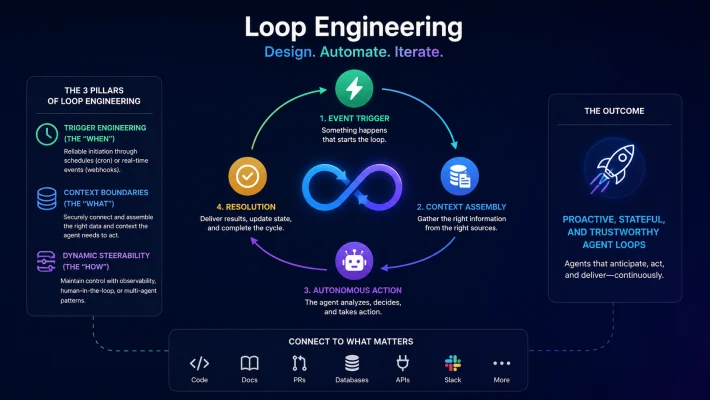
Loop Engineering is the practice of designing the continuous execution cycle of an autonomous agent. Instead of a single stateless interaction, you are engineering a stateful process:
Event Trigger -> Context Assembly -> Autonomous Action -> Resolution.
The Three Pillars of Loop Engineering
To build an automated system that is both effective and trustworthy, you must address three distinct engineering pillars.
Pillar 1: Trigger Engineering (The "When")
A loop needs a reliable initiation condition. In system design, we generally rely on two main patterns:
- Schedule-Based (Cron): Batch processing. For example, triggering an analysis loop every Monday at 10 AM.
- Event-Based (Webhooks): Real-time processing. Your CI/CD pipeline finishes a deployment, firing a webhook that initiates an automated Deploy Verifier.
Pillar 2: Context Boundaries (The "What")
An agent’s ability to act is limited by its context. Loop Engineering requires moving beyond simple prompts and creating secure data connectors. You must define precisely what information, whether that is source code, documentation, previous PRs, or Slack history, is needed to solve the domain problem, integrating diverse sources securely and automatically.
Pillar 3: Dynamic Steerability (The "How")
This is the most critical pillar: control. Fully autonomous, closed-loop systems, or black boxes, are dangerous for core infrastructure. You need mechanisms for intervention and observability.
There are two primary patterns:
- Human-in-the-Loop (HITL) Observability: An agentic loop must not be a black box. You need the ability to view execution in real time, interrupt mid-thought, and steer the session.
- Agent-in-the-Loop (Multi-Agent Patterns): Instead of one massive loop, engineer interconnected systems. Agent A (Generator) creates a draft. Agent B (Critique) automatically reviews that draft before any human interaction.
Real-World Application: The Automated Docs Loop
How is this applied practically? Consider the standard challenge of keeping documentation synchronized with a fast-moving codebase.
Instead of manual updates, you engineer a proactive loop:
- The Trigger: A scheduled cron job running once a week.
- The Context: Secure connections to the source code repository, the documentation repository, and internal Slack channels for deployment notes.
- The Execution: The routine spins up in managed infrastructure, performs a diff on all merged code changes, identifies undocumented features, and automatically generates a new Pull Request with draft documentation updates, notifying the team maintainer via Slack.
Final Thoughts
We are moving past the era of Prompt Engineering, where success was defined by how you talked to the model. We are now entering the era of Loop Engineering, where success is defined by how you integrate the model into continuous, stateful, event-driven architectures. Master the loop, not just the prompt.