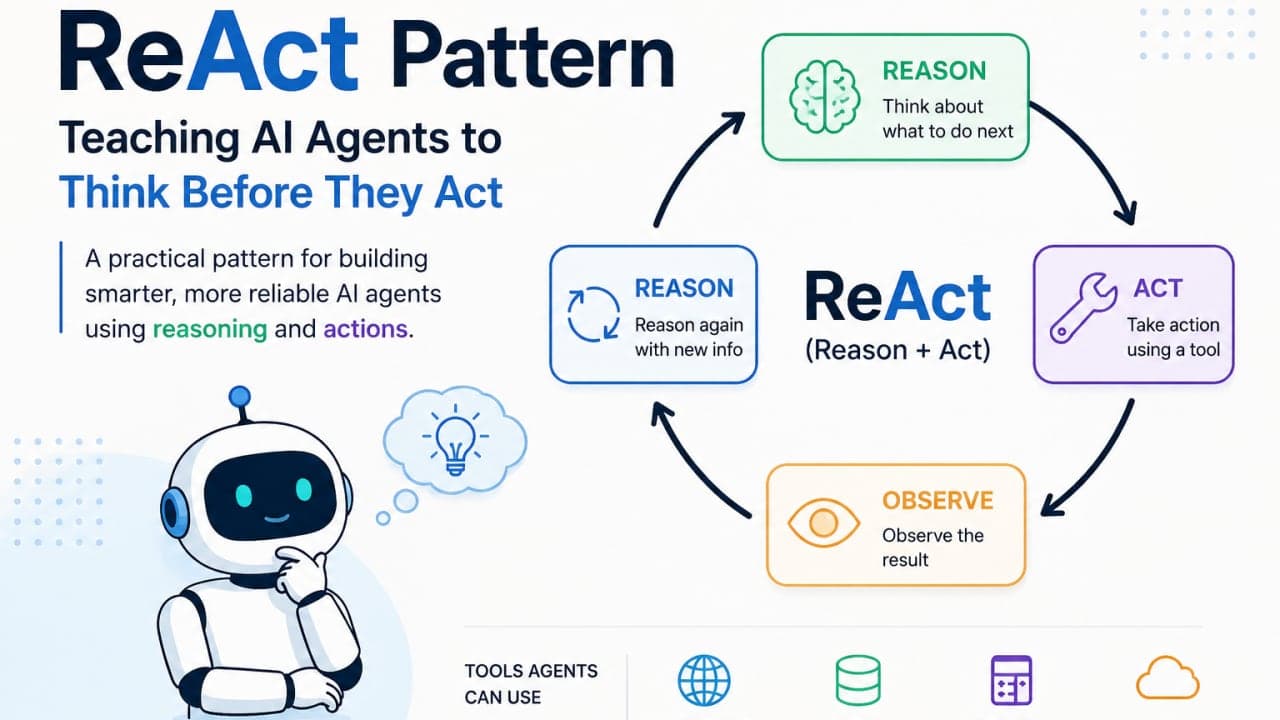
Most LLMs follow a simple flow:
Question → Answer
This works well for straightforward tasks.
But real world problems often require searching, querying APIs, performing calculations, or validating information before arriving at the right answer.
That's where the ReAct (Reason + Act) pattern comes in.
Instead of jumping directly to an answer, the agent alternates between reasoning and acting.
Question
↓
Reason
↓
Act (Tool)
↓
Observe
↓
Reason
↓
Act
↓
Final Answer
💡 The Core Idea
The agent first reasons about what it should do next, then executes that action using a tool such as:
- Web Search
- Database
- Calculator
- External API
The result of that action becomes the input for the next reasoning step.
In other words, it's a feedback loop, not a one shot prediction.
Example
User: "What's the weather in Mumbai this weekend? Should I carry an umbrella?"
A traditional LLM might rely on its existing knowledge.
A ReAct Agent would:
- Reason that it needs live weather data.
- Call a weather API.
- Observe the forecast.
- Reason about the rain probability.
- Recommend whether to carry an umbrella.
The key difference is simple:
Think → Act → Observe → Repeat
🚀 Why ReAct Matters
- Improves accuracy
- Reduces hallucinations
- Makes better use of tools
- Enables dynamic decision making
- Produces more reliable AI agents
Most production AI agents today, whether built with LangGraph, OpenAI Agents SDK, or similar frameworks, use some variation of the ReAct pattern.
The best AI agents don't answer immediately.
They reason before they act, and act before they answer.